The Mail Merge Text Kit
Merge a list into text messages, names and file names without surprises: count what the network bills, find the one character that triples a send, budget for the longest name, check the names a converter gets wrong, and give every generated file a key
DocBetter's Character Counter measures one text: its characters, its alphabet and the SMS segments it is billed as. A merge measures a whole list at once. A template drafted in a word processor carries a curly apostrophe that switches every message to UCS-2 (70 characters a text instead of 160), the names on the list make every message a different length, an all-caps export comes back from title case with names spelled wrong, and two clients with one name share one generated file. This kit counts a template the way the network does, finds the look-alike characters and the ones that cost two units, works the headroom each merge field leaves, and prices a send at your own price per segment. In its worked example, an appointment reminder to a 12-name list goes from 36 segments as drafted to 15 with every fact kept, and nobody's name changes; at an example $1 per hundred segments and 2,400 people a month that is $864 a year against $360. It then converts an all-caps list and flags the names a person must read (5 of the 6 wrong ones in its example, and why DeShawn cannot be recovered from capitals), and puts the record ID first in every generated file name: 10 sample clients make 7 file names by name, 10 with the ID. Every list, name and price in it is an example; segment sizes follow the GSM standard, providers can count differently, and it does not cover the rules on consent or opt-out wording. Included: 24 printable pages, 7 steps, a template fit worksheet, a list check sheet, a send cost sheet, a file name plan, reference tables and a swap card, a quickstart, and a personalised sheet worked from the numbers DocBetter's tools publish for your own text (never the text itself).
Look inside
Two full pages from the kit, exactly as printed. Click either to read it at full size before you decide.
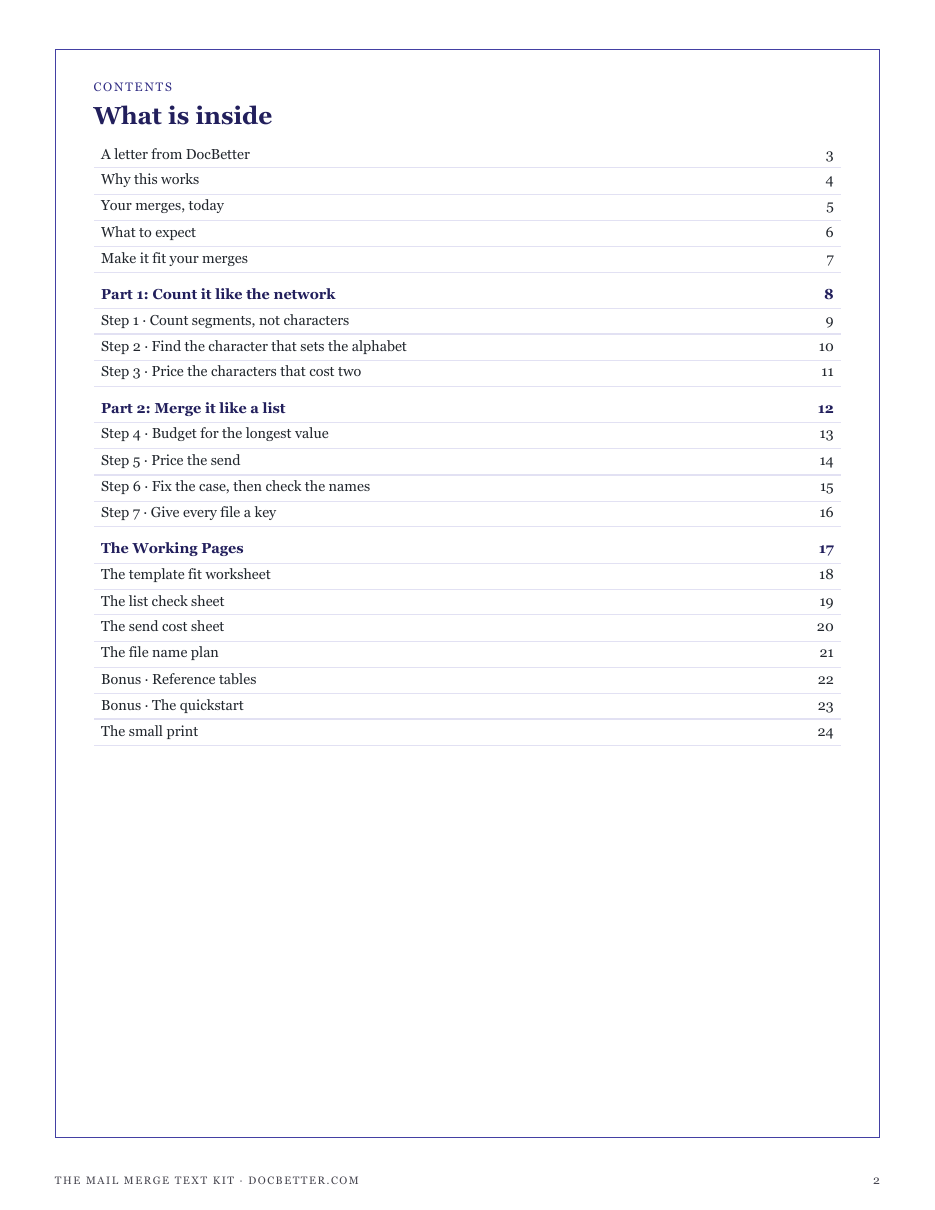
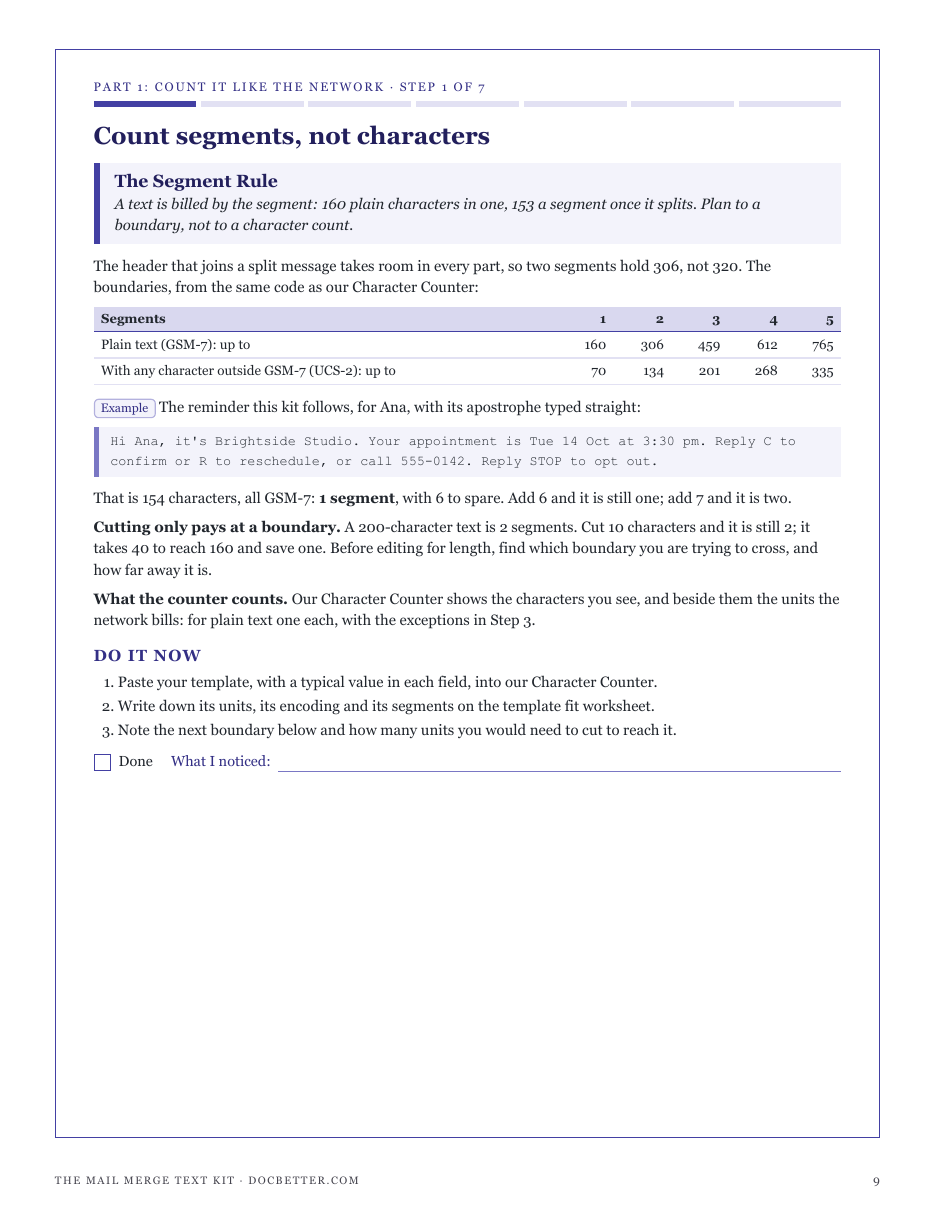
What is in it
- The Segment Rule: SMS billed by the segment, 160 then 153 in GSM-7 and 70 then 67 in UCS-2, and why cutting only pays at a boundary
- The One Character Rule: the curly apostrophe, dash or no-break space that switches a whole message to UCS-2, found and swapped
- The Escape Rule: the GSM-7 characters that cost two units, and emoji that cost two or more
- The Longest Name Rule: the headroom each merge field leaves, and the names whose letters switch a message to UCS-2
- The Send Cost Rule: segments times recipients times your own price, per send and per year, version against version
- The Names Need a Person Rule: an all-caps export converted, the names flagged for a person, and fixing it at the form
- The Key Rule: a record ID first in every generated file name, so accents and shared names cannot overwrite a file
- Working pages: a template fit worksheet, a list check sheet, a send cost sheet and a file name plan
- Reference tables: headroom by fixed length, the look-alike swap card and the two-unit characters
- A quickstart, and a personalised sheet worked from your own tool inputs
- ✓ 24 printable pages
- ✓ 10 sections, worksheets and templates
- ✓ A second PDF worked out from the numbers you enter
- ✓ No account needed, just an email address
- ✓ Instant download; link valid 7 days
Price includes any taxes. Sold by GrabURL, who handle checkout and support. The charge appears on your statement as GrabURL.
The kit picks up where the free Character Counter leaves off. The counter tells you how one text measures: its characters, its alphabet (GSM-7 or UCS-2) and the SMS segments it is billed as. The kit measures a whole list merged into a template: the headroom each field leaves, the longest value and the names that switch a message to UCS-2, and what a send costs per year at the price you enter. It then takes the list through the Case Converter, with the names a person has to check, and the Text Slug Generator, with a record ID in every file name so no generated file overwrites another. Segment sizes follow the GSM standard; providers can count differently, so their own counter and price page are the final word. Every name, list and price in it is an example. It counts characters and does not cover the rules on consent or opt-out wording, and no price or saving is promised.