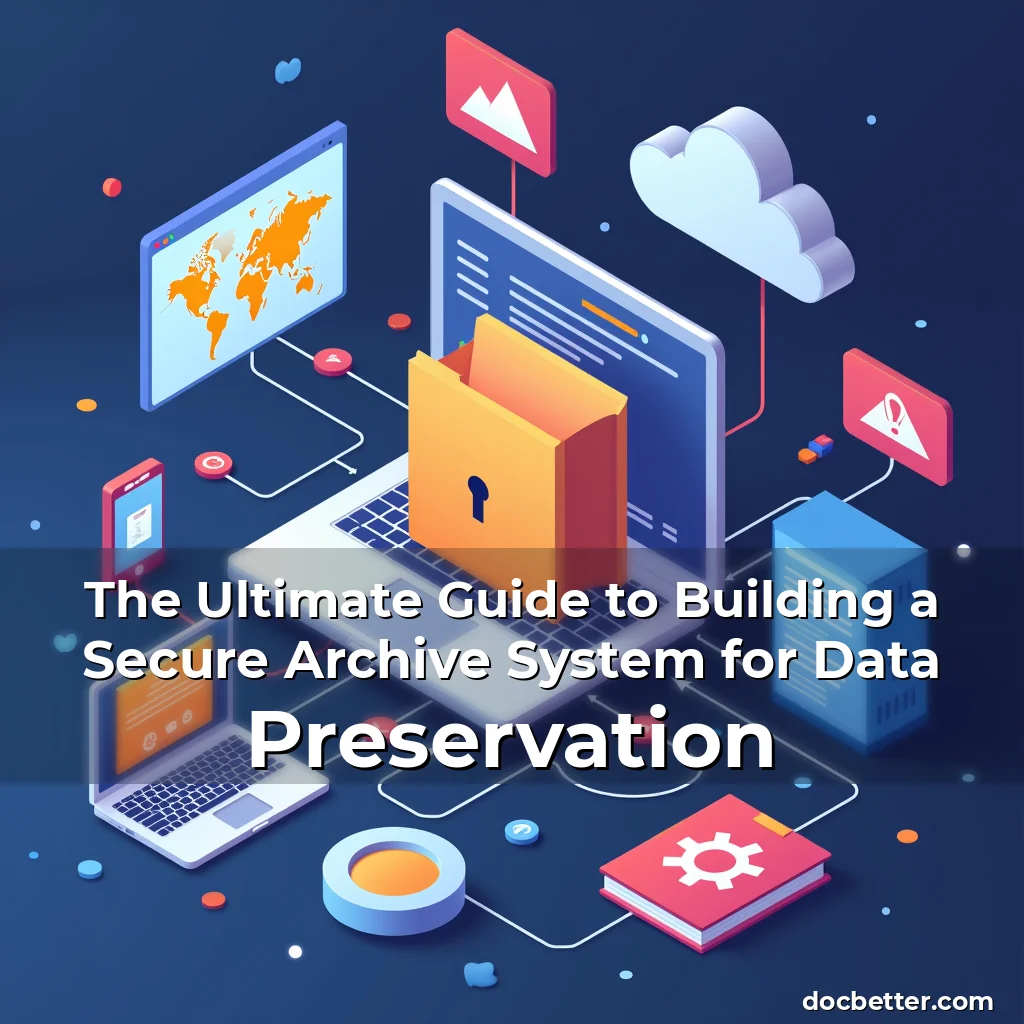
The Ultimate Guide to Building a Secure Archive System for Data Preservation
In an era where digital information is both our greatest asset and most vulnerable target, establishing a secure archive system has become essential for organizations and individuals alike. A well-designed secure archive not only safeguards sensitive data from unauthorized access but also ensures its longevity through robust storage mechanisms.
Data breaches have surged by over 68% since 2020 according to IBM’s Cost of a Data Breach Report, emphasizing the critical need for advanced archival solutions that can withstand evolving cyber threats. This guide will explore the principles behind creating resilient data archives capable of protecting against modern security challenges while maintaining accessibility when needed.
Fundamental Principles of Secure Archiving
A secure archive begins with understanding core principles that form its foundation. These include confidentiality, integrity, availability, and non-repudiation – commonly referred to as the CIA triad extended with additional elements. Confidentiality ensures that only authorized users can access stored information, while integrity guarantees data remains unchanged during storage and retrieval.
Availability focuses on ensuring data can be accessed promptly whenever required, even under adverse conditions. Non-repudiation adds another layer by providing verifiable proof of actions taken within the archive system, which is crucial for legal compliance and audit trails.
- Confidentiality: Protects data from unauthorized disclosure using encryption techniques and strict access controls
- Integrity: Maintains data accuracy through checksum verification and cryptographic hashing methods
- Availability: Ensures continuous access via redundancy strategies and disaster recovery plans
- Non-repudiation: Provides irrefutable evidence of user interactions through digital signatures and logging mechanisms
Designing Robust Storage Infrastructure
Creating a secure archive requires careful consideration of physical and virtual storage infrastructure components. Modern archival systems often combine cloud-based solutions with on-premises hardware to balance cost-effectiveness with control over sensitive data assets.
Cloud storage providers offer various security features such as end-to-end encryption, multi-factor authentication, and automated backups. However, choosing between public, private, or hybrid cloud models depends largely on organizational needs regarding data sovereignty and regulatory requirements.
Evaluating Cloud Providers for Archival Purposes
When selecting a cloud provider for long-term archiving, key factors include their compliance certifications, geographic data center locations, and incident response capabilities. For example, AWS Glacier offers low-cost archival storage with built-in encryption and version control features suitable for less frequently accessed data sets.
Microsoft Azure’s Archive Blob tier provides similar functionality at competitive pricing points, making it attractive for enterprises seeking scalable solutions without compromising security standards. Both platforms support integration with third-party tools for enhanced monitoring and analytics.
Implementing Strong Access Controls
Effective access management is crucial in preventing unauthorized modifications or deletions within archived records. Implementing role-based access control (RBAC) systems allows administrators to define precise permissions based on job functions rather than individual identities.
This approach minimizes potential vulnerabilities by limiting each user’s ability to interact with data they don’t require for their responsibilities. Multi-layered authentication protocols further strengthen these protections by requiring multiple forms of identification before granting access rights.
Encryption Strategies for Data Protection
Encrypting data at rest and in transit significantly enhances the security posture of any archive system. Advanced Encryption Standard (AES) with 256-bit keys remains industry standard for encrypting static data due to its strong resistance against brute-force attacks.
TLS 1.3 protocol provides state-of-the-art protection for data transmission across networks, offering improved performance compared to previous versions while maintaining high levels of cryptographic strength. Regularly updating encryption algorithms keeps defenses current against emerging attack vectors.
Ensuring Data Integrity Through Verification Mechanisms
Maintaining data integrity involves implementing systematic checks to detect and prevent unauthorized alterations. Cryptographic hash functions generate unique identifiers for files that change predictably when content modifies, enabling reliable validation processes.
Regular audits combined with automated verification routines help identify discrepancies early, allowing prompt corrective measures before compromised data affects downstream operations. Blockchain technology presents innovative possibilities for immutable record keeping within archival contexts.
Disaster Recovery Planning for Archives
A comprehensive disaster recovery plan must address risks ranging from natural disasters to cyberattacks targeting archival repositories. Geographically distributed backup sites ensure continued operation during localized outages or catastrophic events affecting primary facilities.
Rapid failover capabilities minimize downtime by automatically rerouting traffic to secondary locations containing up-to-date copies of archived materials. Testing these procedures regularly confirms effectiveness and identifies areas needing improvement prior to actual emergencies.
Leveraging Automation for Enhanced Security
Automation plays a vital role in maintaining consistent security policies across extensive archival collections. Automated classification tools can analyze incoming documents to determine appropriate handling procedures based on sensitivity levels and retention periods.
Scheduled maintenance tasks such as patch updates and vulnerability scans reduce human error while ensuring systems remain protected against known exploits. Machine learning algorithms enhance threat detection capabilities by identifying patterns indicative of suspicious activity.
Compliance Considerations in Secure Archiving
Adhering to relevant regulations governs how organizations handle personal identifiable information (PII), financial records, medical histories, and other sensitive categories within their archives. GDPR mandates specific protections for EU citizens’ data including right to erasure and breach notification timelines.
COPPA imposes stringent rules on collecting children’s online personal information, requiring explicit parental consent before storing such data permanently. HIPAA establishes rigorous guidelines for healthcare-related documentation preservation ensuring patient privacy remains intact throughout archival lifecycles.
Monitoring and Auditing Practices
Ongoing monitoring helps maintain visibility into archive activities, detecting anomalies that could indicate security incidents or policy violations. Real-time alerting systems notify administrators instantly upon observing unusual behavior patterns potentially signaling intrusions or misconfigurations.
Periodic audits review access logs, modification timestamps, and permission changes to verify alignment with established governance frameworks. These assessments reinforce accountability among personnel responsible for managing sensitive datasets.
Human Factors in Archive Security
Despite technological advancements, human element remains pivotal in securing archival environments. Employee training programs educate staff about phishing attempts, social engineering tactics, and best practices for password management reducing internal risk exposure.
Establishing clear incident response protocols prepares teams to react swiftly when breaches occur minimizing damage extent. Encouraging proactive reporting culture enables timely discovery of vulnerabilities before attackers exploit them effectively.
Future Trends Shaping Secure Archiving
Emerging technologies are redefining approaches toward data preservation security. Quantum computing poses new challenges necessitating development of post-quantum cryptography algorithms resistant to future decryption capabilities threatening existing encryption schemes.
Artificial intelligence applications extend beyond mere automation; they now assist in predictive modeling scenarios analyzing historical trends to anticipate potential threats proactively. Edge computing decentralizes processing power enhancing responsiveness times particularly beneficial for time-sensitive archival operations.
Conclusion
Building a secure archive system demands meticulous attention to multiple interrelated aspects spanning technical implementation to operational practices. By integrating proven methodologies alongside forward-thinking innovations, organizations can create resilient infrastructures safeguarding invaluable digital assets against contemporary risks.
To implement effective secure archiving today, prioritize evaluating your organization’s specific needs first then gradually incorporate recommended security enhancements addressing identified gaps systematically ensuring sustained protection over time.
“`<|End of article|>“`