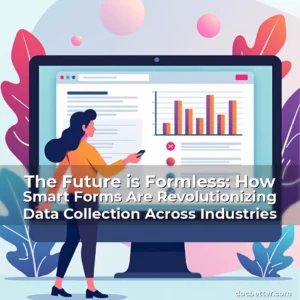

The Future of Data Collection: How Smart Forms Are Revolutionizing User Interaction
In an era where data is king, traditional paper-based or static digital forms are becoming obsolete. Enter smart forms—a dynamic innovation that transforms how users interact with information collection processes.
These intelligent tools adapt to user input, validate responses in real-time, and streamline workflows by reducing errors and improving efficiency across industries.
Understanding the Evolution from Static to Dynamic Forms
The journey from basic fill-in-the-blank forms to interactive smart forms has been driven by advancements in web technologies and artificial intelligence.
Static forms require users to complete every field regardless of relevance, leading to frustration and incomplete submissions. In contrast, smart forms use conditional logic to show only relevant fields based on previous answers.
This evolution not only enhances user experience but also significantly reduces form abandonment rates by making interactions feel personalized rather than transactional.
Early versions of dynamic forms emerged in the early 2000s with simple branching logic, while modern implementations leverage AI for predictive input suggestions and error detection capabilities.
- Conditional Logic: Displays relevant questions based on prior selections, such as showing payment options only after selecting a subscription plan.
- Real-Time Validation: Immediately checks inputs against predefined rules, alerting users to incorrect formats before submission.
Core Features That Define Smart Form Technology
Smart forms incorporate several key features that distinguish them from conventional data entry methods.
One fundamental element is adaptive UI design, which adjusts layout and formatting dynamically based on device screen size and orientation.
Intelligent validation mechanisms go beyond simple format checking by analyzing context and suggesting corrections when possible.
Integration with backend systems allows automatic data synchronization, eliminating manual transcription errors that plague many organizations today.
Modern implementations often include built-in analytics dashboards that track completion rates, common drop-off points, and overall user engagement metrics.
How Smart Forms Improve Business Efficiency Across Industries
In healthcare settings, smart forms enable faster patient intake through automated question routing and instant documentation updates.
Retail businesses benefit from inventory management forms that auto-populate product details and generate purchase orders seamlessly.
Educational institutions utilize these tools for streamlined student registration, automatically calculating tuition fees and course prerequisites in real time.
Financial services companies employ smart forms for loan applications that assess creditworthiness instantly using embedded algorithms.
A survey conducted by Gartner found that organizations implementing smart form solutions experienced up to 68% reduction in processing times compared to traditional methods.
The Role of Artificial Intelligence in Enhancing Form Interactions
AI-powered smart forms analyze patterns in user behavior to predict what information might be needed next.
Machine learning models can identify common mistakes and proactively suggest corrections or additional clarifying questions.
Natural language processing enables voice-to-text functionality, allowing users to complete forms verbally instead of typing manually.
Some advanced systems even offer sentiment analysis to detect confusion or frustration during form completion.
According to Forrester Research, AI-enhanced forms have shown a 42% increase in completion rates due to their ability to anticipate user needs and provide contextual assistance.
Security Considerations in Smart Form Implementation
Data security remains a top priority when designing any online form solution, especially those handling sensitive information.
Implementing end-to-end encryption ensures that all transmitted data remains protected from interception attempts.
Password protection and multi-factor authentication add critical layers of defense against unauthorized access.
Regular security audits help identify vulnerabilities in both front-end interfaces and back-end databases.
Compliance with regulations like GDPR and HIPAA requires careful implementation of privacy controls and data retention policies.
- Field-Level Encryption: Encrypts individual data elements rather than entire transmissions for enhanced security.
- Tokenization: Replaces sensitive data with non-sensitive equivalents during transmission, minimizing exposure risks.
User Experience Design Principles for Effective Smart Forms
Crafting intuitive smart forms begins with understanding the target audience’s needs and expectations.
Clear visual hierarchy helps guide users through complex processes by emphasizing essential information and actions.
Predictive text features reduce keystroke effort by suggesting likely completions based on historical data.
Progress indicators reassure users about their position within lengthy multi-step forms.
Accessibility considerations ensure that visually impaired individuals can navigate and complete forms successfully using assistive technologies.
Best Practices for Implementing Smart Forms Successfully
A successful smart form implementation starts with defining precise objectives and identifying the most appropriate use cases.
Conducting thorough user testing at various stages helps uncover usability issues before full deployment.
Establishing robust version control systems ensures that changes can be tracked and rolled back if necessary.
Continuous monitoring of performance metrics allows for iterative improvements over time.
Training staff to understand and support smart form functionalities fosters better adoption and troubleshooting capabilities.
Creating comprehensive documentation supports ongoing maintenance efforts and knowledge transfer between teams.
Future Trends Shaping the Next Generation of Smart Forms
Advancements in quantum computing may soon enable ultra-fast form processing capabilities previously thought impossible.
Blockchain technology promises to revolutionize form verification through immutable record keeping and decentralized identity management.
Voice recognition software will continue evolving toward perfect accuracy, enabling fully hands-free form completion experiences.
Augmented reality interfaces could transform how users interact with forms through immersive visualization techniques.
As IoT devices become increasingly prevalent, smart forms will need to accommodate diverse input modalities ranging from wearable sensors to environmental monitors.
Measuring Success: Key Performance Indicators for Smart Form Analytics
Tracking completion rates provides direct insight into how effectively your forms engage users throughout the process.
Analyzing drop-off points helps pinpoint areas requiring improvement in navigation flow or content clarity.
Monitoring response times indicates whether system performance aligns with user expectations.
Evaluating data quality metrics reveals trends in inaccurate or inconsistent entries needing refinement.
Assessing conversion rates shows how well smart forms contribute to broader business goals like lead generation or customer acquisition.
Gathering feedback through post-submission surveys offers qualitative insights complementing quantitative data analyses.
Conclusion
Smart forms represent a transformative shift in how we collect, process, and utilize data in our daily operations.
By embracing this innovative approach, organizations can achieve unprecedented levels of efficiency, accuracy, and user satisfaction across all departments and functions.